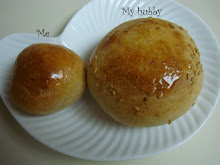
We've been enjoying bread so much that I've started to make 2 loaves per week. Now that I have two KAF cook books, I am practically trying out everything from there whenever occasion arises. Now that I've tried a few quick bread recipes, I begin to understand what is so quick in the quick bread. It's the time of mixing, not the time of baking. So far, my quick bread batters tend to be more moist than the yeast bread dough. Therefore, the quick breads take longer to bake, and yield a more moist texture than the yeast breads.
Recipe: Beer herbed seeds bread (1 medium loaf)
Ingredients:
- 1 cup KAF all-purpose flour
- 1 cup KAF whole wheat flour
- 1/2 cup fine semolina flour
- 1 TB baking powder
- 1+1/4 tp table salt
- 1 TB white sugar
- 1 12-oz O'doul's ember, less 1/4 cup
- 2 TB vegetable oil
- 1/4 cup sunflower seeds
- 1/4 cup flax seeds
- 1 tp each of dried rosemary, parsley, oregano, and marjoram
Procedure:
1. Mix all the flours, the baking powder, salt and sugar in one large bowl.
2. Mix all the herbs and seeds in a small bowl.
3. Add O'doul's very slowly and stir. As the beer mixes with the flour, it stirs up a lot of bubbles. Try to avoid any explosion. Save about 1/2 bottle until the seeds and herbs are added in, so that the herbs may get hydrated. Add the oil while mixing the batter.
4. When the batter is almost thoroughly formed, add in the seeds and the herbs. Mix thoroughly.
5. Grease a 8.5"x4" pan (this time I use 9"x5", but a smaller one should be enough). Pour the batter into the pan.
6. Preheat oven to 350F. Bake on middle rack for 30 minutes. Then cover with foil and continue baking until a temperature comes out clean.
7. Allow to cool on rack. Then wrap in plastic to cool overnight before slicing.
Results:
2:20pm, ingredients ready:
2:21pm, beer added slowly to the mixture of dry ingredients:
2:24pm, half the beer saved to hydrate the seeds and herbs while mixing the batter:
2:25pm, final batter ready:
2:28pm, thickness of the batter when poured into a greased pan:
2:30pm, the (lack of) spread of the batter:
2:30pm, the height of the batter just before baking at 350F:
2:31pm, leftover beer, not used in the batter:
3:03pm, loaf baked 30 minutes:
3:03pm, loaf's height when baked 30 minutes:
3:03pm, loaf covered with foil and continued baking at 350F:
3:27pm, loaf baked 55 minutes, internal temperature 180F:
3:27pm, thermometer coming out clean:
3:33pm, the edge of the loaf being easily detached:
3:33pm, loaf's top when done:
3:33pm, loaf's height:
3:36pm, loaf's bottom:
3:37pm, loaf's heel:
3:37pm, loaf's side:
3:39pm, loaf's corner:
3:39pm, loaf's top:
6:34pm, loaf cooled for 3 hours:
6:39pm, a center-of-loaf slice:
6:39pm, a heel-of-loaf slice:
6:40pm, loaf yielding 14 slices, easily sliced, giving a cut knife:
6:40pm, the crispy crust and the chewy crumb of the loaf:
6:47pm, a bite on a heel slice, very crispy crust, very tender crumb, with distinctive chewy bites on the seeds:
7:31pm, remaining slices wrapped to freeze:
Next day, comparison of three recent loaves (all frozen): the oatmeal flaxseed bread (bottom left), the zucchini quick bread (top), and the beer herbed seeds bread (bottom right):
Observations:
1. In my last few experiments, I try out quick breads. What I have noticed is that wheat-based quick breads tend to have a more dramatic oven spring, but also fall back much more substantially than wheat-based yeast breads. This is probably because the gluten has not developed enough to hold the shape of the quick bread. The preparation time of quick bread is usually less than 30 minutes. There is no time to proof the yeast or to let the dough rise. If any gluten develops at all, it's during the mixing time and the beginning of the baking.
2. According to the KAF whole grain cook book, "practically all quick breads benefit from an overnight rest before slicing. The moisture in the dough redistributes itself as the breads sits, improving its texture and slicing qualities. This characteristic couldn't be better suited for whole grains, which become even more appetizing when given some extra time to absorb the loaf's moisture. The bran softens, the flavors meld, and any spices or vanilla have more time to evenly suffuse the bread."
3. Indeed, after allowing the loaf to cool for 3 hours, the loaf is a lot easier to slice. The flavor is very good. I like the rich combination of herbs and seeds, along with some unusual sweet that comes from the beer.
Showing posts with label sunflower seeds. Show all posts
Saturday, June 26, 2010
Wednesday, June 2, 2010
My 46th experiment: Sunflower seed whole wheat bread
Having given away the loaves that I've baked, I am now baking a loaf for our own home. It is to be my favorite whole wheat bread with orange juice and seeds.
Day 2, 5:37pm, loaf starts baking:
Day 2, 5:52pm, loaf baked 15 minutes, then to be covered with foil for the remaining time:
Day 2, 6:22pm, loaf baked 40 minutes:
Day 2, 6:22pm, thermometer coming out clean:
Day 2, 6:23pm, loaf's height:
Day 2, 6:25pm, loaf's heel:
Day 2, 6:26pm, loaf's bottom:
Day 2, 6:26pm, loaf's side:
Day 2, 7:02pm, loaf cooled for 30 minutes, with no significant change to the loaf's crust:
Day 2, 7:08pm, loaf yielding 15 slices:
Day 2, 7:08pm, end-of-loaf slice:
Day 2, 7:09pm, center-of-loaf slice:
Day 2, 7:09pm, nice crust with sesame very secure:
Recipe: Sunflower seed whole wheat bread (make 1 medium loaf)
Ingredients:
- 3 cups King Arthur whole wheat flour
- 1 tp active dry yeast
- 4 TB orange juice, freshly squeezed
- about 1 cup warm water
- 2 TB vegetable oil
- 2 TB firmly packed dark brown sugar
- 1+1/4 tp salt
- 1/2 cup raw sunflower seeds
- 1 tp dark sesame oil
- sesame seeds for toppings
- 1 tp dark sesame oil
- sesame seeds for toppings
Procedure:
1. Proof yeast in 1/2 cup warm water.
2. Mix flour, salt, and sugar in a large bowl. Add proofed yeast, orange juice and half of the remaining warm water. Mix to form a dough. Add the remaining water incrementally 2 TB at a time, until the dough is well hydrated. The resultant dough should be rather smooth and strong. It should be able to stand on its own as a bowl. Do not attempt to add flour to fix it unless it cannot stand.
3. Add in the oil. Form a smooth ball. Leave it on the counter for 30 minutes or so. Then chill it overnight, covered with wrap.
4. On the next day, warm dough up on counter top.
4. Grease a 8.5"x4.5" medium pan with butter, and dust with a little flour. Gently deflate the dough. Add in the sunflower seeds. Shape the dough into a log. Place it in the greased pan and allow to rest until the dough rise to about 1" over the rim of the pan.
5. Preheat oven to 350F. Bake for 40 minutes. For the first 15 minutes, bake uncovered at 350F. Then cover top with foil and continue baking. Loaf is done when internal temperature reaches 190F.
Results:
Day 1, 11:29pm, initial dough formed:
Day 1, 11:39pm, texture of dough; observe how it does not stick to the hand:
Day 1, 11:39pm, dough ready to rest overnight:
Day 2, 8:14am, dough being punched down the next morning, after overnight fermentation:
Day 2, 8:15am, dough to return to the fridge to chill until afternoon:
Day 2, 3:39pm, dough taken out of the fridge to warm up:
Day 2, 4:10pm, dough's height when out of the fridge for 30 minutes:
Day 2, 4:13pm, dough's texture:
Day 2, 4:14pm, dough being stretched and sesame oil added:
Day 2, 4:21pm, dough with sunflower seeds and kneaded:
Day 2, 4:25pm, dough shaped:
Day 2, 4:26pm, dough preparing to rest:
Day 2, 5:30pm, dough rested for 1 hour:
Day 2, 5:36pm, dough brushed with egg wash of egg white and 1% milk, then topped with sesame seeds:
Day 2, 5:36pm, dough's height when just about to bake:
Day 2, 5:37pm, loaf starts baking:
Day 2, 5:52pm, loaf baked 15 minutes, then to be covered with foil for the remaining time:
Day 2, 6:22pm, loaf baked 40 minutes:
Day 2, 6:22pm, thermometer coming out clean:
Day 2, 6:23pm, loaf's height:
Day 2, 6:25pm, loaf's heel:
Day 2, 6:26pm, loaf's bottom:
Day 2, 6:26pm, loaf's side:
Day 2, 7:02pm, loaf cooled for 30 minutes, with no significant change to the loaf's crust:
Day 2, 7:08pm, loaf yielding 15 slices:
Day 2, 7:08pm, end-of-loaf slice:
Day 2, 7:09pm, center-of-loaf slice:
Day 2, 7:09pm, nice crust with sesame very secure:
Observations:
1. This time, I try to make the dough a little dryer. Then I use the delayed fermentation.
2. Normally, with delayed fermentation, 1/2 tp of yeast will be enough. But for a whole wheat loaf, I use 1 tp to ensure good oven spring.
3. Wow! This loaf tastes great! But I think 1/2 cup of sunflower seeds is just too many. Probably 1/4 or 1/3 cup will be good enough.
4. The wonderful thing about this loaf is the texture of the dough and the amount it rises during the chilling time. It's a very pleasant loaf to work with.
5. After the loaf comes out of the oven, there is no significant change to the crust after it cools down. This is very good as the gluten in the bread is strong enough to hold the bubbles in shape after the air cools down.
6. This loaf does not have the same amount of oven spring as my 44th loaf of sesame and sunflower seeds , using atta flour and double the amount of yeast. Comparing the taste of the two loaves, the atta flour loaf actually stands out better. Maybe it's because white flour has less of its own flavor, and allows the flavors of the seeds to stand out better.
7. Dark sesame oil is very strong. So, use with discretion. 1 tp is about all that is needed for a loaf.
While this bread tastes very very good by itself, it's almost a waste to eat it as a sandwich bread with meat and other stuff. The great flavors of the nuts and seeds are basically overpowered by the fillings. But then, for the health conscious, maybe this is still prepared to a plain whole-wheat loaf.
Labels:
100% whole wheat,
sandwich loaf,
sesame,
sunflower seeds
Subscribe to:
Posts (Atom)


