Showing posts with label bread flour. Show all posts

Monday, June 7, 2010

My 47th experiment: Bacon bread

Just took a break from the routine life. Coming back home, I find myself renewed strength to try something new again. Here is another adaptation of Bernard Clayton's recipe. His original recipe gives a sandwich loaf. Mine yields a big round loaf. Quite a success. I bake this loaf to thank the friend who introduced me to bacon. What better gift can you give in return for such an act of kindness?? None other than a loaf of homemade bacon bread.

Recipe: Bacon bread (1 round loaf)

Ingredients:
- 2+1/2 cups King Arthur bread flour
- 3 tps active dry yeast
- 1 tp coarse kosher salt
- 2-3 TB brown sugar
- 1 egg,  saving 1 TB of egg white for egg wash
- dash of crushed coriander seeds
- about 3/4 cup warm water
- about 8-10 pieces of bacon, cooked to crispy and drained of fat, cut into very fine pieces

Procedure:
1. Proof yeast in about 1/4 cup of warm water.
2. Mix bread flour, salt, brown sugar and coriander seeds in a large bowl. Use hands to break the brown sugar into fine grains and mix well with the flour.
3. Add proofed yeast and egg into the large bowl. Start mixing. Add warm water incrementally in 2-3 TB until the dough is roughly formed and very moist.
4. Allow the dough to rest for a few minutes. Knead the dough again to make the texture homogenous. Then allow the dough to rest covered with plastic wrap in a warm oven until its volume has doubled.
5. Stretch out the dough and add the bacon. Knead well. Then allow the dough to rest in a bowl, top-side-down, until volume increases by 1.5 times. Then turn dough out onto a baking pan lined with parchment paper.
6. Preheat oven to 400F. Brush dough top with egg white while waiting the oven to heat up.
7. When oven is hot, place the dough in the middle rack and bake at 375F for 10-15 minutes, until top is golden and hardened. Then cover the loaf with foil. Bake for another 30 minutes, until internal temperature reaches 190F.
8. Take loaf out. Brush with butter.
9. If not served right away, then return loaf to oven without turning heat on, to let the crust harden in the residual heat for about 30 minutes.

Results:
2:04pm, pre-cooked bacon:

2:47pm, bacon heated for nearly 2 minutes in total,

2:47pm, initial dough:

2:54pm, texture of dough after some short rest and kneading:

2:59pm, dough ready to rest:

3:17pm, dough rested 18 minutes in a warm oven:

3:19pm, dough mixing with bacon, observe the stickiness of the dough (probably because its bread flour):

3:23pm, final dough:

3:28pm, final dough ready to proof in a bowl, with the top side down (observe the clean hand):

3:45pm, final dough proofed 17 minutes with non-sticky surface:

3:49pm, final dough turned out of the bowl to rest top-side-up on aluminum pan lined with parchment paper:

3:50pm, dough's height:

3:55pm, dough ready to bake:

3:56pm, dough in oven:

4:06pm, loaf baked 10 minutes uncovered, then covered with foil for the remaining time:

4:32pm, loaf baked 36 minutes:

4:33pm, loaf's internal temperature:

4:33pm, thermometer coming out clean:

4:34pm, loaf's height:

4:34pm, loaf's bottom and side:

4:34pm, loaf's top buttered:

4:36pm, clean parchment:

5:11pm, loaf cooling:

5:11pm, loaf along the long side:
Next day morning:


On baking day, a small piece of final dough is taken out to make a sample roll for tasting

3:30pm, sample roll made to rest:

3:45pm, sample roll proofed 15 minutes:


4:11pm, sample roll baked 15 minutes:

4:11pm, sample roll's top and bottom:


4:11pm, sample roll's interior:


Observations:

  1. In the experiment, the big thing is the use of bacon. Since bacon has fat, there is no need to add any extra fat to the dough. The original dough is a bit sticky. But once the bacon is added, it makes magic, turning the dough into a bouncy one.
  2. When the loaf comes out of the oven, it is very big and spongy. I rub the top with butter to give it a shiny soft crust. However, because the crust is soft, the loaf soon shrinks and wrinkles when the air inside cools down. Since I plan to give this loaf away only tomorrow, it makes sense for me to keep its shape as much as possible. So I return the loaf to the warm oven. This allows the crust to harden a bit. However, when the bread comes out of the oven, it continues to collapse and shrink.
  3. The egg white wash gives the loaf a golden colored crust during baking. However, it's the butter that gives the crust a shiny glaze. The butter also serves to soften the crust.

Sunday, May 2, 2010

My 32nd experiment: dinner buns with whole wheat

Having succeeded to make a batch of gorgeous buns, I am now trying to introduce some whole grain into the buns too. This time I am using a combination of 1 cup of bread flour to 1/2 cup of whole wheat flour. The sugar level has been reduced.

Recipe: Improvised dinner buns

Ingredients:
- 1 cup King Arthur unbleached bread flour
- 1/2 cup King Arthur whole wheat flour
- 2 tp active dry yeast
- 1 large egg
- 1 TB white sugar
- 1 TB melted butter (accidentally clarified)
- 3/4 tp salt
- about 1/4 to 1/2 cup warm water
- 2 TB bread flour for adjustment
- water roux made from 1 TB bread flour mixed with 1/4 cup water
Toppings:
- egg wash made with 1 tp egg white
- sesame seeds

Procedure:
1. Proof yeast with 2 TB of warm water.
2. Mix bread flour, whole wheat flour, white sugar and salt in a medium bowl.
3. Add cooled water roux, egg and proofed yeast to the medium bowl. Use a fork to stir all the ingredients together to form a dough. Knead the dough intermittently. When dough is in rather good shape, add in the melted butter and rub it into the dough. Knead the dough vigorously to homogenize the mixture. After that, the dough will appear smooth but not oily. At this point, if dough appears to be too moist, add flour and knead gently. The final dough should have strength to hold itself together and stand up in the bowl.
4. Allow the dough to rise until volume has doubled. Then punch the dough down.
5. Cut dough into small pieces of 1" length and roll the pieces into balls. If they are to be saved for future baking, dust with a little flour and roll gently to coat all surfaces. Then freeze them.
6. To prepare dough for baking: apply egg wash on top of the dough balls and then sprinkle sesame on top. Then allow the dough balls to proof on non-stick surface until the volume has doubled.
7. If a powerful toaster oven is used, bake for 5 minutes at 400F (without preheating) and then 10 minutes at 300F. If large oven is used: preheat oven to 400F and bake for 10 minutes or until top is golden brown.

Results:

3:06pm, initial mix of all the ingredients except butter:

3:12pm, initial dough:

3:16pm, dough kneaded twice:

3:25pm, dough kneaded the third time after adding melted butter (I accidentally boil the butter, so it is clarified and gives out a very nice smell):

3:28pm, 2 TB bread flour added to dough and dough is reworked so that it can hold its shape standing on the bowl. Then it is allowed to rest:

3:44pm, dough doubled its volume in just 15 minutes in the residual heat of the hot oven:

3:47pm, dough punched down (just by repeated folding, not too vigorously):

3:49pm, dough shaped into a log to be cut up:

3:50pm, dough being cut up; observe the large bubbles inside even after being punched down:

3:51pm, dough cut up into balls and dusted with flour:

4:08pm, dough balls to be frozen are vigorously rubbed between the palms to squeeze out all gas bubbles inside:

4:08pm, dough ball to rise and bake on the same day:

4:56pm, dough balls proofed 50 minutes; right: without vigorous rubbing since the 1st rising ; left: vigorously rubbed and chilled for a few minutes, then allowed to warm up again:

5:31pm, after another 30 minutes: the dough ball without vigorous rubbing has over-risen and collapsed; the dough ball with vigorous rubbing is rising slowly; the dough balls in freezer have semi-frozen:

5:33pm, semi-frozen dough balls are dusted with flour especially on the bottoms to prevent sticking. Then they can be placed in the same bag for storage.

If the dough balls keep expanding before it's time to bake, then keep folding them inward when they fall out of shape. Keep them moist. 

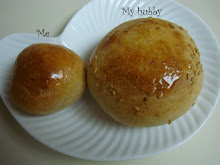
7:34pm, two buns baked in toaster oven (without pre-heating) first at 400F for 1-2 minutes, then for about 5-10 minutes at 300F until top is light brown.


7:35pm, two buns brushed with butter:

7:41pm, one bite of the bun shows a spongy interior, very soft and tasty:

Observations:
1. In this experiment, my two objectives are, first, to study the use of bread flour and wheat flour instead of all-purpose flour, and second, to study how to control the rise of the rolls given such a large quantity of yeast.
2. In today's experiment, dinner is delayed. The large dough ball expands much faster than I desire it to. It falls out of shape after half an hour. So whenever it falls out of shape, I fold it back into a ball and allow it to continue rise. I do not punch it down because I am not sure when I am ready to bake them. The small dough ball has already been punched down before, so it rises less rapidly. Eventually it still expands out of shape, and I have to fold it back into a ball again. 
3. Despite the delayed dinner, the buns turn out to be in good shape when I am ready to cook. They bake very well and have a great oven spring. The large one is especially impressive in its oven spring.
4. I bake them in the toaster oven without preheat. So I let them heat at 400F for the first 1-2 minutes. The surface becomes very lightly golden. Then I turn the heat down to 300F and let them cook until the tops are nicely browned. 
5. Wow! When the buns come out of the oven, their tops are burning hot. Butter melts instantly, giving a nice gloss.
6. The taste of this loaf is very good. It's savory (with a light taste of salt) and a distinctive but mild taste of whole wheat. Very good!

This is certainly another of our very memorable evenings with these little warm and lovely buns.