Showing posts with label white bread. Show all posts

Tuesday, June 29, 2010

Croutons

I thought croutons are just toasted bread. I didn't know that there is an art even in the making of crouton. This I learnt from Bernard Clayton. When nicely done, the croutons are both crispy and easy to crunch. When overdone, they are rocks.

Recipe: Croutons

Ingredients:
- day-old staled white bread (not too staled, else the resultant croutons will be like rocks)
- a little butter, in a stick, best lightly softened

Procedure:
1. Make sure the white bread is thinly sliced. Rub each side of each slice lightly with a stick of butter. Make sure that the surface is uniformly touched with just a faint gloss of butter, but not in thick patches. If there is too much butter, the fat will drip off when the bread pieces are heated.
2.  Carefully cut each slice into squares less than 1" on each edge.
3. Spread the bread squares flat on a tray lined with aluminum foil.
4. Turn toaster oven to 400F. Place tray in toaster oven and bake for about 5 minutes. Keep a close watch of the bread while heating. Once the top side is lightly brown, flip. Take out any pieces that is golden brown on both sides. Discard any over-brown pieces. They are burnt.
5. Allow to cool on a rack for about 30 minutes. Then pack and seal.

Results:

Hearth white bread, very thinly sliced (less than 1/4") and cut to squares:


The same bread pieces toasted at 400F for about 5 minutes; observe that some pieces have been over-browned and need to be discarded:

When the croutons just come out of the oven, they need to be cooled, best on a rack to minimize re-absorption of the moisture that has come out of the crouton; the cooled croutons can be placed on a tray:

Store in air-tight containers.

Monday, June 28, 2010

My 59th experiment: Back to basics

When I talked about French toast, my husband said, "Oh! yum. I grew up with that!" What a nice thing to have for breakfast! But to make French toast, we need staled white bread. So here comes our white bread. I'm glad to have purchased the KAF cook book. Now I can try out their recipe and make a reasonable comparison.


Recipe: White bread (1 medium loaf)

Ingredients
- 3 cups KAF all purpose flour
- 1+1/4 tp salt
- 3 TB sugar
- 3 TB melted butter
- 1/4 cup potato flour
- about 1 cup cold 1% milk
- 2 tp active dry yeast

Procedure:
1. Mix yeast in 1/4 cup milk. (Not a very effective way to proof the yeast, but better than just adding the active dry yeast directly into dough)
2. Melt butter.
3. Mix flour, salt sugar and potato milk thoroughly in a medium bowl.
4. Add the yeast and milk mixture into the bowl. Mix with the flour to form a dough. Add milk progressively, about 1/4 cup each time, until the dough is formed. It may take a little while for the hydration to become uniform. Resultant dough is very soft, smooth and elastic. If dough is sticky, add a little flour.
5. Allow dough to rest for 10-30 minutes. Then add melted butter into the dough. Rub and knead until all the butter has worked into the dough, and the dough becomes smooth and not shining with a layer of grease any more.
6. Place dough in bowl, cover with plastic, and allow to rest in a warm place until volume doubles. About 1-2 hours.
7. Punch down the dough. Fold it a few times and shape it into a log. Place the log in a 8..5"x4.5" loaf pan. Cover top with plastic. Allow to proof again, until dough rises to about 1" over the rim of the pan.
8. Preheat oven to 350F.
9. Bake loaf for 35-40 minutes. After the first 10-15 minutes, cover with foil.

Results:
9:50am, ingredients:

10:10am, initial mixture of yeast, milk and dry ingredients:

10:17am, dough formed without oil:

10:20am, dough sticky to hand, needed 2 TB of flour for adjustment:

10:41am, dough with 3 TB of melted butter rubbed in, ready to proof:

11:19am, dough rested 30 minutes:

12:58pm, dough rested 2 hours:

1:42pm, dough rested 3 hours:

1:42pm, dough being gently de-gased:

1:42pm, dough with a silky texture:

1:45pm, dough finished punching:

1:49pm, dough shaped into a log to proof in pan:

1:49pm, dough's height before proofing:

4:06pm, dough risen 2 hours and 15 minutes:

4:07pm, dough's risen height:

4:07pm, dough's bubbles to be pinched away:

4:12pm, dough brushed with milk:

4:12pm, dough ready to bake:

4:13pm, dough's height just before baking:

4:35pm, loaf baked 22 minutes:

4:58pm, loaf baked 40 minutes:

4:58pm, loaf's internal temperature exceeded 190F:

4:58pm, loaf's edge detached from pan:

4:58pm, thermometer coming out very clean:

4:58pm, loaf's height:

4:59pm, loaf's top:

4:59pm, loaf's bottom:

5:00pm, loaf's side:

5:01pm, loaf's heel:

5:01pm, loaf's length:

5:03pm, loaf's crust starting to wrinkle just 5 minutes out of the oven:

7:38pm, loaf cooled 2 hours and 40 minutes, in the open oven; crown remains high after cooling:

7:40pm, loaf being sliced, neatly and nicely done without fuss:

7:44pm, 15 slices (thick slices on both heels):

7:45pm, beautiful silken, milky white crumb with a shade of gold:


7:45pm, thin amber crust that is neither hard nor soft; it's just tight like a layer of skin that wraps around the flesh of the bread:

7:45pm, a center-of-loaf slice:

7:46pm, a heel-of-loaf slice:

7:49pm, a bite on the heel, so good even by itself:

7:53pm, wrapped to freeze:

7:53pm, still too reluctant to let the bread go... I'm obsessed!

Observations:
1. Wow! This is an impression loaf! I love its color so very much.
2. The oven spring is spectacular!
3. As expected, the crust collapses a little within 5 minutes after coming out of the oven. I decide to keep it in the open oven to cool gradually.
4. Look at how beautiful the crumb and the crust are!

This loaf is a revelation! Its crumb has such a fine color: that of milky white blended with a beautiful tint of gold. The crust is pure amber, thin, neither hard not chewy, just a little tight. Talking about aroma, the warm sweetness of it is unmistakable while it is being baked; and it linger in subtlety for hours after. You'd notice there has been fresh bread the moment you step in to the house. Oh, as for flavor: tender like silk, neither noticeably sweet nor salty, just the perfect blend of milk, sugar and salt at its finest, with a light shade of butter!

Just one bite on this simple white bread, and you'll understand why the white flour has been the elite food since the Romans days, and has remained so for nearly 20 centuries. How sad that the popular culture considers white flour to be junk food today! Whatever they tell you, your own palate is still the best judge.

Thursday, March 11, 2010

My 11th experiment: retarded white bread :)

I'm trying a new recipe this week. The objective is to try out retardation. So I am making almost the entire dough (instead of a starter) from the beginning, and let it have delayed fermentation in the fridge. The dough is seasoned with salt but without any sugar or oil. It's very lean no doubt. It's also highly hydrated, though not quite a poolish yet.


Recipe: White bread with retarded fermentation

Ingredients:
Initial dough
- 2 cups of unbleached flour
- 1 cup + 3 TB warm water
- 1/2 teaspoon (tp) kosher salt
- 1 tp active dry yeast
Final dough
- some whole wheat flour for dusting
- 1.5 TB pesto paste
- 2 tp vegetable oil

Procedure:

Day 1:
1. Mix the flour with salt in a medium bowl.
2. Add 2-3 TB of warm water to the dry yeast to dissolve it.
3. Then add the dissolved yeast into the flour mixture. Start mixing the flour to form a dough. Add water in small amount of about 2-3 TB each time while mixing, until a wet dough is formed. The dough should be very sticky, yet it is able to pull away from the bowl in mostly one piece.
4. Chill in the fridge overnight. Occasionally take out to fold the dough a few times when possible.

Day 2:
1. Take the dough out of the fridge and fold it a little.
2. Allow to warm to room temperature for 2-3 hours.
3. Then set the dough on a counter dusted with flour. Fold it a few times. Cut into two pieces.
4. Fold each piece of the dough a few times. While folding, be very careful not to burst the air bubbles inside. The bubbles can be folded into the dough. It's not too easy to punch down the large bubbles, but it still helps to fold them into the center of the dough.
5. To make a white loaf, grease a small bowl with 1 tp of oil. Shape one piece of dough into a ball and place it into the bowl. Rub a little oil on top of the dough and allow to proof in the bowl.
6. To make a roll with pesto, carefully stretch out one piece of dough on the counter to. The thickness of the dough is about 1/4" to 1/2". Spread pesto paste thinly on the sheet. Then roll up the sheet. Grease a flat pan with 1 tp of oil. Allow the roll to proof on the pan.
7. After the two pieces of dough have increased in volume, preheat oven to 475F. Transfer the round loaf to the pan by inverting the bowl. The round loaf may not be able to keep its shape very well.
8. Score both loaves with a sharp knife dipped in water. Then place them in the oven. Turn oven setting to 400F and bake for 20 minutes.
9. Allow both loaves to cool. Then slice and serve.

Results:

Day 1
7:02pm, dough just mixed for about 20 minutes, with high hydration, but not to the point of a paste. Preparing to chill.

8:07pm, one hour after entering the fridge, dough has expanded, possibly because of the heat that still remains inside before the cold temperature sets in.

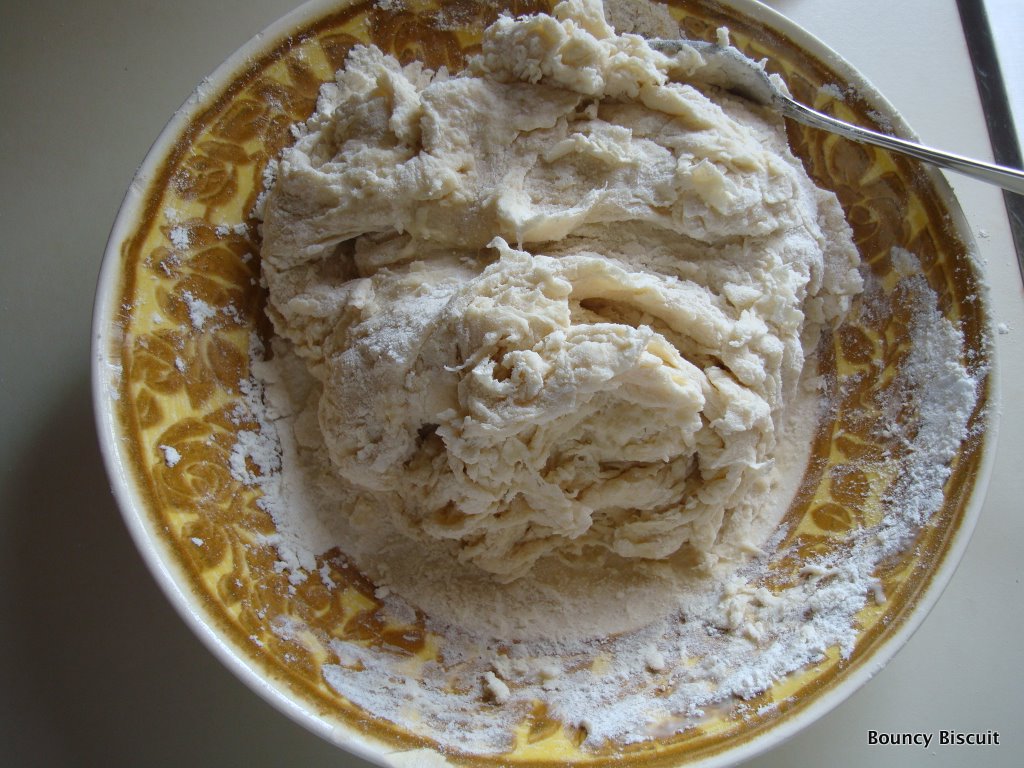
8:29pm, I decided to take dough out to knead it a little more. Observe that the wet dough does not stick to the plastic wrapper.

8:31pm, strength of the dough at this point:

8:35pm, I decided to put dough into a square pan with a little water at the bottom. This may facilitate folding in the future.

Day 2:

10:51am, look of the dough after one night of chilling:


10:53am, this is the stickiness of the dough when handled by a fork. Observe that the dough does not stick too much to the fork.

10:57am, dough has been folded a few times using the fork. Apparently, sufficient gluten has already developed since the initial mixing of the dough.

2:13pm, the risen dough after being left at room temperature for 3 hours:

2:20pm, dough first dusted with flour, then being folded by stretching. 

2:22pm, observe the large bubble on the top right corner of the surface of the dough after it's been folded a few times. There are many such bubbles in the dough. Big as they are, they are actually rather resistant to the pressure of folding. Not easy to burst them or punch them down. The gluten that is wrapping them must be quite tough, remembering that this is a very lean dough with no fat at all.

2:28pm, dough cut into 2 pieces, one for a round white bread, one for a pesto roll:

2:32pm, the piece of dough for making the pesto roll has been stretched by hand on a counter dusted with flour. The bubbles still remain after the stretching.


2:35pm, pesto paste spread on the dough:

2:35pm, the piece of dough for the white loaf has been shaped into a ball, the other piece has been rolled up. Both are ready for proofing:

2:45pm, both loaves have been proofed 8 minutes:

3:13pm, both loaves have been proofed 33 minutes. Observe the distinctive volume increase in the round loaf:

3:21pm, loaves scored and ready to bake:

3:45pm, loaves baked at an oven preheated to 475F. Since both loaves are smaller, they are baked at a higher temperature (400F) for a shorter time (20 minutes) to achieve the browning of the crust. The oil on top of the loaves may also help give them the nice color.

3:46pm, white bread's top view:


3:46pm, white bread's side view:

3:46pm, white bread's bottom view:


4:33pm, white bread cooled and cut into 10 slices:

4:33pm, white bread's end-of-loaf slice:

4:33pm, white bread's center-of-loaf slice:

The other loaf has been given to a friend. So there is no record of how it looks inside.

Observations:

1. I am very satisfied with the volume of the white loaf, given the 1 tp of yeast to 2 cups of flour in the entire dough. The retardation has certainly produced a dough that has good fermentation. 
2. The salt in the dough has not affected the fermentation too significantly in the process of retardation.
3. I have given the dough plenty of stretching while mixing the dough. Apparently, a large amount of gluten has already developed from the initial stage. 
4. The strong gluten may have resulted from the fact that the dough is made of unbleached flour, salt and water alone.
5. The bubbles in the dough distribute primarily on the surface of the loaf. they may simply be the result of weight. I have yet to understand this phenomenon better. Nonetheless, this experiment has given me a very good starting point on making light white breads.
6. The oil rubbed onto the surface of the loaves have given their crusts a nice color.
7. For the roll, the oven spring is strong and the layer of the dough is thin. So the interior bursts out while baking!

Just imagine my joy when my husband waved a slice in the air and exclaimed, "this is very good!" It's the magic of a little yeast in flour, water and salt!