Showing posts with label sweet bread. Show all posts

Saturday, July 17, 2010

My 70th experiment: pineapple coconut sweet bread

Since my very successful experiment with orange and cranberries, I feel more encouraged to try out another fruit bread. I love the light sweetness and the aroma of fruit. Here is one experiment, that spins off from Bernard Clayton's honey pineapple bread. This is a sweet bread, and I don't like the bread to be too sweet. So I use less than a quarter of the sugar in his given recipe. The result is still amazingly great. According to somewhere, the more the sugar, the more the result looks like cake. Mine is definitely not cake-like.

Recipe: My pineapple coconut sweet bread (2 small loaves)

Ingredients:
- 1 cup KAF all purpose flour
- 1/2 cup oat bran
- 1/8 cup coconut powder
- juice from one small can of pineapple, about 1/3 cup
- 1 egg
- 1+1/2 TB brown sugar
- 1/2 tp salt
- 1+1/2 tp baking powder
- 1 TB vegetable oil
- about 2-3 TB water for adjustment

Procedure:
1. Mix flour, oat bran, coconut powder, brown sugar, salt, baking powder in one large bowl. Use fingers to break the brown sugar crumbs and mix thoroughly.
2. Add pineapple juice and egg to the mixture. Mix well to form a thick batter.
3. Add 2 tp oil to the batter. Mix well. Reserve 1 tp of oil to grease two small loaf pans.
4. Spoon batter into greased pans. Use a greased spoon to flatten the top of the batter.
5. Preheat oven to 375F. Bake on middle rack. Cover loaf when top is lightly brown. Bake until a stick stuck into the center of loaf comes out clean.
6. Remove carefully from pan. Allow to cool and age overnight before serving.

Results:
5:30pm, mixing all the dry ingredients carefully:

5:36pm, pineapple juice (about 1/3 cup) from a small can of pineapple:

5:36pm, all ingredients ready for mixing:

5:40pm, initial mixture of the dry and the wet ingredients:

5:42pm, adding oil to the well mixed batter:

5:45pm, final batter, after adding 2-3 TB of additional water to make the batter more like a batter than a dough:

5:46pm, spooning batter into greased mini loaf pans:

5:49pm, batter flattened:

5:50pm, edge of batter in pan:

5:50pm, loaves started baking at 375F:

6:07pm, loaves baked 17 minutes:

6:07pm, loaves resume baking at 375F with covered tops:

6:16pm, loaf baked 26 minutes, internal temperature about 175F:

6:16pm, thermometer coming off clean:

6:17pm, first loaf's top:

6:17pm, first loaf's height:

6:17pm, first loaf's heel:

6:17pm, first loaf's bottom, golden brown, not burnt, but significantly browner than the top:

6:18pm, two loaves' tops:

6:18pm, two loaves' heels:

6:20pm, two loaves' corners:

6:19pm, second loaf's top:

6:18pm, second loaf's side:

6:23pm, second loaf's corner:

6:23pm, second loaf's heel:

6:23pm, second loaf's crack:

Next day:
8:15am, crumb of bread after overnight:

8:15am, a bite:


Observations:
1. When I just finish making the batter, the taste of it is very nice. Generally, when the batter tastes great, the loaf would come out great.
2. The pineapple juice itself is sweet enough to make the loaves sweet. So I add just 1.5 TB additional brown sugar.
3. The 1 egg may help gluing the loaf together because of the substantial amount of oat bran and coconut powder which contribute to no gluten formation.
4. Baking the small loaves at 375F is too high. The sides and bottoms are browned too quickly.
5. A bite into the loaf shows big holes. The crumb is dense otherwise, probably because of the oat bran.
6. After cooling, the bread does not taste as sweet as when hot. But it is still noticeably sweet. The coconut powder is noticeable, giving the bread a nice something to chew. This bread has a large amount of oat bran too. Therefore, its texture is somewhat like breads made with atta flour. This bread tastes great when the crust is toasted to a crunch.

Friday, July 16, 2010

My 69th experiment: orange cranberry bread

Originally, I was planning to try out some of the orange bread recipes from Bernard Clayton and the KAF cookbook. After some juggling here and there, my recipe has become so out of shape that it resembles nothing else. Here it goes:


Recipe: Orange cranberry sweet braid (for 2)

Ingredients:
- 1 cup KAF bread flour
- 1 TB sugar
- 1/4 tp salt
- 1/2 tp orange rind
- 1 TB dried cranberries
- 1 to 1+1/2 TB butter/olive oil spread
- slightly more than 1/2 tp active dry yeast
- 1 TB whole evaporated milk
- juice of half a small orange, about 1/4 cup
- 2 TB water

Procedure:
1. Mix yeast with 1 TB evaporated milk and 2 TB orange juice. Allow to proof for 5 minutes.
2. Mix bread flour, sugar, salt in a medium bowl.
3. Add the wet ingredients to the flour mixture. Add the orange rind.
4. Mix the ingredients to form a soft dough. Allow ample time for the flour to hydrate slowly. If dough is too dry, add the orange juice. When the orange juice is used up, add 1/2 TB water at a time. After every hydration, knead the dough for a few minutes before adding more liquid.
5. When the dough is fully formed, allow to rest for a couple of minutes. Then work on it a little more. The texture should become smooth after rest. If hydration is good, the dough can clean the bowl.
6. Rub in the butter, about 1/4 tp at a time. Knead dough on counter top until smooth. Significant shortening of gluten should be noticeable.
7. Allow dough to rest on counter top until its volume has doubled.
8. Add in the cranberries.
9. Form braid. Allow braided dough to proof on parchment paper until puffy.
10. Bake at 400F for a few minutes until top is brown. Then brush with butter. Bake covered with foil at 350F until done.

Results:
3:40pm, orange rind prepared, orange to be juiced:

3:41pm, flour, sugar, salt mixed:

3:41pm, yeast in 1 TB evaporated milk and 2 TB orange juice, allow 5 minutes to proof:

3:46pm, added proofed yeast to the mixture of dry ingredients:

3:51pm, initial dough, with orange rind and in total 4 TB orange juice:

3:52pm, water added half a tablespoon at a time:

4:01pm, dough formed, but too dry, in need of about 1 tp more of water:

4:06pm, dough properly hydrated and able to clean off the bowl:

4:16pm, dough rested for 10 minutes:

4:18pm, a generous TB of butter spread is prepared to add to dough:

4:19pm, texture of dough before rubbing in the butter:

4:28pm, butter left over, and dough with ample butter:

4:29pm, hand clean but not greasy after handling buttered dough:

4:29pm, dough allowed to rest:

4:55pm, dough rested 25 minutes on counter top:

5:34pm, dough rested 1 hour on counter top:

5:37pm, texture of dough after rest:

5:42pm, cranberries added to dough:

5:43pm, stretching dough into a rope, for dough of bread flour, allow a few minutes of rest after each stretch:

5:45pm, dough stretched to final length and allowed some rest time to keep the shape:

5:49pm, dough folded into a braid, about 1/3 the length of the rope:

5:49pm, dough ready to proof on parchment paper:

6:30pm, dough proofed 40 minutes on warm stove top:

6:30pm, dough's height after proofing:

6:31pm, baking started at 375 to 400F:

6:36pm, braid baked for 5 minutes, browned:

6:39pm, braid generously buttered all over the top:

6:40pm, braid resumed baking with cover at 350F:

7:10pm, braid baked another 30 minutes:

7:10pm, braid's bottom:

7:10pm, braid's side:

7:13pm, braid's top from one side and from another side:

7:33pm, the fold on the braid's top:

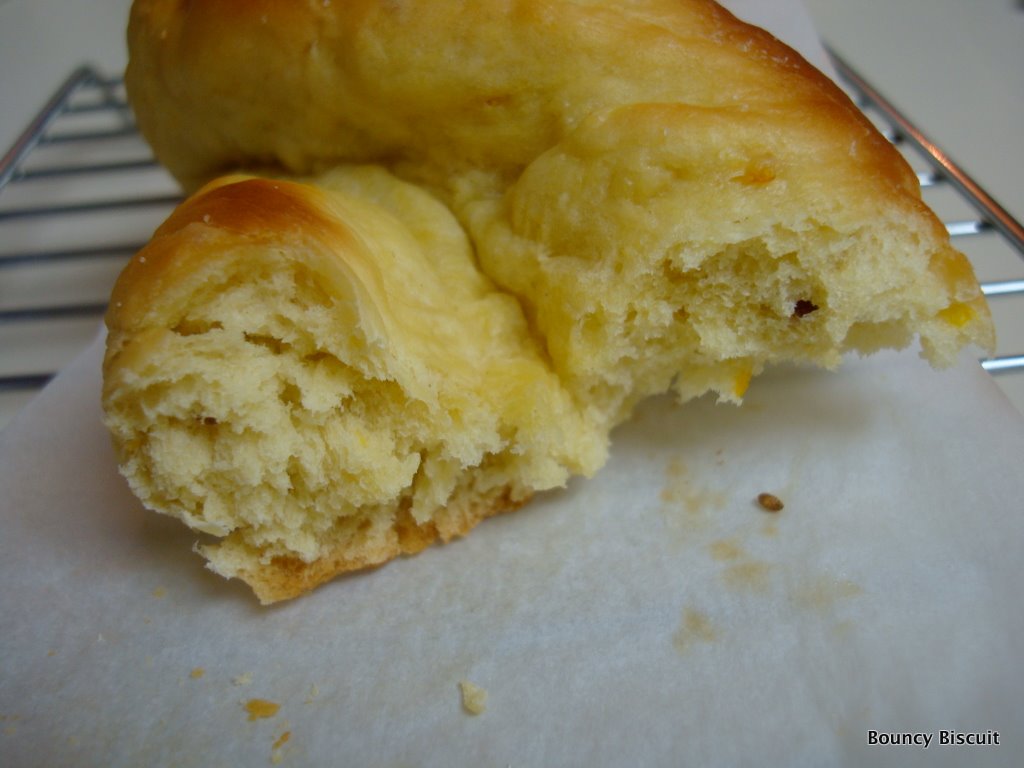
7:35pm, the crumb and the crust of the braid:

7:22pm, braid's interior:

7:12pm, softness of crumb:

Day 2, 9:21am, bread staled overnight:

Observations:
1. Maybe I've brushed a little too much butter during the baking. As a result, the bread's crust does not harden. It remains soft throughout.
2. This bread has a rather fine and distinctive flavor of orange. There is a little sourness, which may be from the orange or the cranberry. The amount of orange rind is just right, noticeable but not too strong.
3. The loaf has a beautiful yellow color. I think it's from the orange, the milk, the sugar and the butter. I don't use any egg in this recipe.
4. Tender and fresh as it is when just come out of oven, this loaf stales fast. After just 2 hours, the torn side of the crumb is already dry.
5. The look of this loaf overnight reminds me of those uninviting loaves at the international grocery stores. Their aroma is great, but their look and the texture is not. I gather that those must be fresh loaves that have no preservatives, and therefore go stale in a very short time.

This lovely orange bread leaves me with a very fond memory of something sweet and soft, like candy floss. I totally love it, and consider it a bread for special occasions. To find out how to enjoy this loaf, I go so far as to open a bottle of cream sherry. The sherry is a little too sweet for this bread though.